Compulsory primary school (Coppino law)
1877 Rome, Italy
In short
When Italy was united, almost eight Italians in ten could not read or write. In 1877 the law brought in by the minister Michele Coppino made primary school compulsory for children aged 6 to 9. Town councils had to open schools, and parents who did not send their children could be fined. In the countryside, though, many children went on working, and the rule was only obeyed little by little.
Why it matters It was a decisive step towards the idea that learning is the right of every child.
Source: Treccani, Dizionario Biografico, entry “Coppino, Michele”
Study card about 5 minutes of reading
The story
A country of illiterates
In 1861, when the Kingdom of Italy was born, three Italians out of four could neither read nor write. In some regions, above all in the South and in the countryside, more than nine people out of ten were illiterate. Many children, at six or seven years old, were already working in the fields, in the mines or in workshops, and poor families had neither the time nor the money to send them to school. In many villages there were not even school buildings, and the teachers, who were paid little, were often poorly trained.
The problem had been seen even before unification. In the Kingdom of Sardinia, in 1859 the minister Gabrio Casati had passed a law that organised education: after unification in 1861 it was extended to the whole of Italy. The Casati Law provided for two years of free primary school, in theory compulsory for children. But in reality it was left to the municipalities, which had to pay for teachers and premises, and many poor municipalities did not do so. Nobody checked whether children went to school, and there were no penalties for parents who did not send them.
The Coppino Law
After years of discussion, on 15 July 1877 Parliament passed a new law, proposed by the Minister of Education Michele Coppino. The “Coppino Law” laid down that all children, boys and girls, from six to nine years old, had to attend primary school, for a three-year course. Parents who did not send their children to school had to pay fines, although in practice these penalties were rarely applied. The municipalities had to organise the schools and pay the teachers.
There were other new things. The law removed the teaching of the Catholic religion from the compulsory subjects, and replaced it with the “first notions of the duties of man and of the citizen”: it was a sign of a more secular state school. It also provided that teachers should have adequate training, and that school should teach reading, writing and arithmetic, and the basics of history, geography and science.
A school hard to fill
Making school compulsory was not enough. Many families, very poor, did not want to give up their children's work, which brought home a little money, or often did not understand what school was for. There was a lack of classrooms, desks and books, and in many villages male and female teachers lived in difficult conditions. Many women teachers, often very young, taught in small isolated mountain or country villages, on very low salaries. The children who attended often lived far from home, with few books and, in winter, no shoes.
Yet things slowly changed. Books were circulating in schools that told stories for the new Italy: “Cuore” (“Heart”) by Edmondo De Amicis (1886), the diary of a boy, which showed the life of a class in Turin and taught a sense of duty and solidarity, and “The Adventures of Pinocchio” by Carlo Collodi (1881–83), the story of a puppet who grows up.
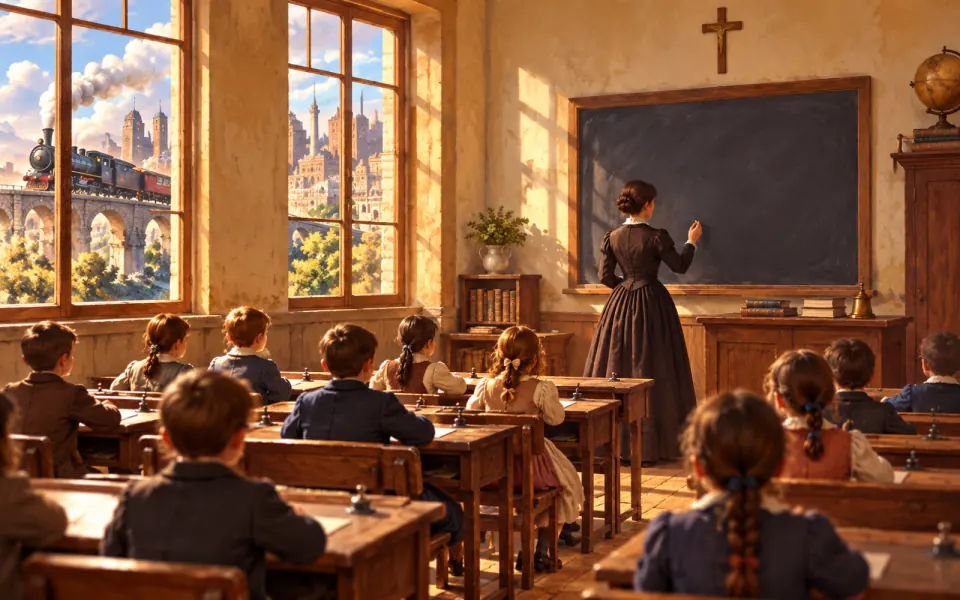
A class in those years was very different from one today: often a single cold room, with wooden two-seater desks, the blackboard, the inkwell and the pen nib for writing in exercise books, and the teacher keeping together children of different ages. They learned by heart, recited the times tables in chorus and copied pages from the primer.
The later stages
In 1904 the Orlando Law raised compulsory schooling to twelve years old; in 1911 the Daneo-Credaro Law put primary schools in the hands of the State, taking them away from poor municipalities; in 1923 the Gentile reform raised the school-leaving age to fourteen. In 1962 the single middle school, the same for everyone, was established, and in 2007 compulsory education was extended to ten years, up to the age of sixteen.
Why it happened
The Coppino Law came from the awareness that Italy, to become a modern country, had to educate its people. The politicians of united Italy understood that illiteracy was an obstacle to the economy, to democracy and to national unity: for example, a farmer who could not read could not understand the laws or take part in public life.
It was helped by the idea, widespread across Europe in the 19th century, that education was a right and a duty. Other countries, such as Prussia, had already made school compulsory, and France did so a few years later, in 1882.
What changed
Compulsory primary school slowly brought illiteracy down: from 78% in 1861, to 48% in 1901, to 38% in 1911, down to less than 13% in 1951. Today almost everyone in Italy can read and write. The change was also speeded up by military service, by emigration and, in the 20th century, by radio and television.
School also played an important part in uniting the country, because it taught a common language, Italian, to children who spoke different dialects. Many Italians of the time never spoke Italian at home, but learned it at school.
The right to education is now written in Article 34 of the Constitution: “School is open to everyone. Primary education, provided for at least eight years, is compulsory and free”. In the world, however, there are still millions of children, especially girls, who do not go to school: the road begun in 1877 is not finished.
Key people and places
People
- Michele Coppino
- Piedmontese politician and man of letters (1822–1901): Minister of Education, he proposed the law of 1877.
- Gabrio Casati
- Lombard politician (1798–1873): Minister of Public Education in 1859, author of the Casati Law.
- Edmondo De Amicis
- Italian writer (1846–1908): author of “Cuore”, a school novel.
- Carlo Collodi
- Italian writer (1826–1890): author of “Pinocchio”.
- Maria Montessori
- Doctor and educator (1870–1952): with her school she changed the way children are taught.
Places
- Rome, Parliament of the Kingdom
- The seat where the Coppino Law was passed on 15 July 1877.
- Turin
- The city where Michele Coppino taught and where “Cuore” is set.
Good to know
- The Coppino Law dates from 15 July 1877 and made the first three classes of primary school compulsory.
- In 1861 about three Italians out of four were illiterate.
- With the Coppino Law, religious teaching was no longer compulsory.
- The book “Cuore”, from 1886, tells of a school year in a class in Turin.
- Today, according to the Constitution, education is compulsory and free for at least eight years.
Find out more
- Wikipedia, “Michele Coppino” en.wikipedia.org
- Wikipedia, “Gabrio Casati” en.wikipedia.org
- Wikipedia, “Heart (novel)” en.wikipedia.org
- Wikipedia, “Illiteracy” en.wikipedia.org
Related events
- The unification of Italy1861 · Age of revolutionsUnited Italy was born in 1861, with three quarters of the population illiterate.
- Maria Montessori's Children's House1907 · Early 20th centuryMontessori renewed nursery education a few decades later.
- Television spreadsabout 1950 · Early 20th centuryTelevision, with “Non è mai troppo tardi” (“It's never too late”), taught adults to read.
- Malala wins the Nobel Peace Prize2014 · TodayToday Malala fights so that all girls can go to school.
Before and after, in the era “Age of revolutions”
Event 22 of 25
 BeforeNewcomen's steam engine1712
 BeforeThe European Enlightenmentabout 1720
 BeforeDiderot's Encyclopédie1751
 BeforeWatt's steam engine1769
 BeforeThe American Revolution1776–1783
 BeforeThe first hot-air balloon flight1783
 BeforeThe French Revolution1789–1799
 BeforeThe metric system1795
 BeforeJenner's vaccine1796
 BeforeVolta's battery1800
 BeforeNapoleon becomes emperor1804
 BeforeThe Congress of Vienna1815
 BeforeThe first public steam railway1825
 BeforeNiépce's photographabout 1826
 BeforeManzoni's The Betrothed1827
 BeforeThe electric telegraph1844
 BeforeThe revolutions of 18481848
 BeforeDarwin publishes On the Origin of Species1859
 BeforeThe Expedition of the Thousand1860
 BeforeThe unification of Italy1861
 BeforeThe labour movementabout 1864
- You are hereCompulsory primary school (Coppino law)1877
 AfterA practical electric light bulb1879
 AfterThe first modern motor car1886
 AfterThe Lumière brothers' cinema1895
Listen / Read next
- Music to read by: Cinematic JourneyEpic film-style music, no lyrics, by Ciro Simone IrmiciSpotifyYouTube Music
- How Italians spoke: the dialectsNonnese, the dictionary of Italian dialects
Meanwhile, elsewhere in the world
Other events of the era “Age of revolutions”
- Newcomen's steam engine
- The European Enlightenment
- Diderot's Encyclopédie
- Watt's steam engine
- The American Revolution
- The first hot-air balloon flight
- The French Revolution
- The metric system
- Jenner's vaccine
- Volta's battery
- Napoleon becomes emperor
- The Congress of Vienna
- The first public steam railway
- Niépce's photograph
- Manzoni's The Betrothed
- The electric telegraph
- The revolutions of 1848
- Darwin publishes On the Origin of Species
- The Expedition of the Thousand
- The unification of Italy
- The labour movement
- A practical electric light bulb
- The first modern motor car
- The Lumière brothers' cinema
