The revolutions of 1848
1848 Palermo, Milan, Paris, Vienna and many other European cities
In short
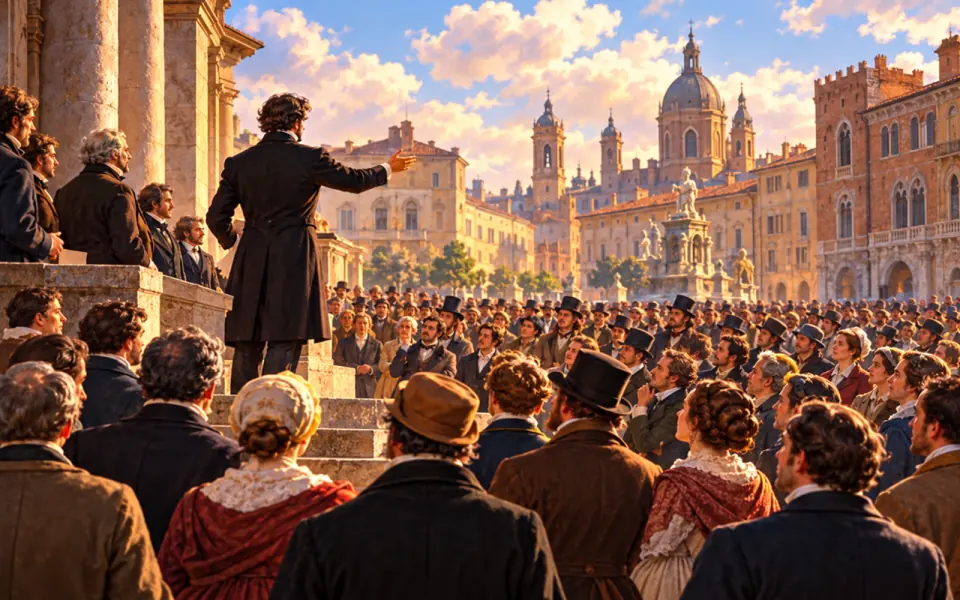
In 1848, in many European cities from Paris to Vienna, people took to the streets to demand constitutions, freedom and independence. In Italy the first revolt broke out in Palermo in January; in March the people of Milan drove out the Austrians in the Five Days. King Charles Albert granted the Statuto, the constitution of the Kingdom of Sardinia, and the First War of Independence began. Almost all the uprisings were crushed, but the Statuto Albertino stayed in force.
Why it matters That year shook Europe so much that in Italian ‘fare un quarantotto’ (‘to make a forty-eight’) still means to cause total chaos.
Source: Encyclopaedia Britannica, “Revolutions of 1848”
Study card about 5 minutes of reading
The story
A Europe on the boil
In 1815 the Congress of Vienna had tried to bring Europe back to the order that existed before the revolution: kings and emperors returned to their thrones, and ideas of freedom and national independence were put down. But ideas cannot be wiped out. Over the following decades many people, above all young people, students, professionals and workers, dreamed of constitutions, freedom of the press, elections and a nation-state, for peoples who were divided, like the Italians and the Germans, or ruled by others, like the Poles, the Hungarians and the Czechs. Meanwhile the social question was growing: in factories and cities workers lived in terrible conditions, and in 1846–47 bad harvests and potato blight made hunger worse.
By January 1848 the mood was ready. Nobody knew where the spark would fly.
The Spring of Nations
The revolt began in Palermo on 12 January 1848, against the king of the Two Sicilies, Ferdinand II, and forced the king to grant a constitution. A few weeks later, on 22–24 February, a revolution broke out in Paris: King Louis Philippe abdicated and the Second Republic was proclaimed, with universal male suffrage. The news spread from capital to capital like wildfire. In March there were uprisings in Vienna, where the powerful minister Metternich fell and had to flee; in Berlin, where the King of Prussia granted reforms; in Budapest, where the Hungarians led by Lajos Kossuth demanded autonomy; in Prague and in other cities. It was called the “Spring of Nations”.
In that same month of February 1848, in London, two Germans, Karl Marx and Friedrich Engels, published a small book, the “Communist Manifesto”, which opened with the words “A spectre is haunting Europe”: it was about the struggle between workers and employers.
Italy in 1848
In Italy the uprisings were mixed up with the demand for independence from Austria, which ruled Lombardy and Veneto. On 4 March the King of Sardinia, Charles Albert, granted a constitution, the Albertine Statute, which would remain in force, with changes, until 1948. On 18 March, in Milan, a revolt broke out against the Austrian government: for five days, the “Five Days”, men, women and boys and girls of the people and of the middle class, with few weapons, barricades of furniture and stones, and roof tiles thrown from the rooftops, fought against the army of Marshal Radetzky, who in the end withdrew. In Venice the Republic of San Marco was proclaimed, led by Daniele Manin.
On 23 March Charles Albert declared war on Austria, and the First War of Independence began, with volunteers joining from all over Italy. But things changed: the Italians were divided, Pope Pius IX and the king of Naples withdrew their support, and the Austrian army reorganised. After the defeat at Custoza, in July 1848, and another defeat at Novara, in March 1849, Charles Albert abdicated in favour of his son Victor Emmanuel II.
In Rome, after the Pope fled, the Roman Republic was proclaimed in February 1849, led by the triumvirate of Giuseppe Mazzini, Carlo Armellini and Aurelio Saffi, with Giuseppe Garibaldi in charge of the military defence. It approved a modern constitution, which abolished the death penalty and guaranteed freedom of conscience. But French troops, sent by Louis Napoleon, besieged the city, and in July the Republic was defeated. A young poet of only 21, Goffredo Mameli, the author of the words of the anthem “Fratelli d'Italia”, was wounded in the defence and died of his wounds.
The end of the spring
In a few months the reaction regained control: in Vienna and Prague the army reconquered the cities; in Hungary the revolution was crushed in August 1849 with Russian help; in Frankfurt the parliament that wanted to unite Germany did not succeed. In France, in December 1848, Louis Napoleon Bonaparte, Napoleon's nephew, was elected president, and in 1852 he proclaimed himself emperor with the name of Napoleon III.
Why it happened
The uprisings of 1848 came from three causes meeting: the desire for political freedom, in states ruled by absolute monarchs; the desire for national independence; and the social and economic crisis, with hunger and unemployment.
They spread quickly because news travelled by telegraph and newspapers, and because in many countries there were the same problems. It was a European phenomenon, not only an Italian one.
What changed
The revolutions of 1848 seemed to fail: the old governments came back almost everywhere. But they left lasting results. In the Austrian Empire serfdom was abolished. In Piedmont the Statute stayed in force, and the Kingdom of Sardinia, led by Victor Emmanuel II and then by the prime minister Cavour, became the point of reference for Italians who wanted unity. Cavour, and Garibaldi, who became a popular hero, would lead Italy to unity between 1859 and 1861.
In 1848, at Seneca Falls, in the state of New York, a group of women wrote a “Declaration of Sentiments” to demand the same rights as men, including the vote: it was the beginning of the movement for women's suffrage.
Historians say that 1848 was a “missed turning point”, but it taught many people that unity and freedom could not be won by spontaneous popular action alone: they needed organisation, alliances and military force. This lesson was important for the protagonists of Italian and German unification.
Key people and places
People
- Giuseppe Mazzini
- Italian patriot and politician (1805–1872): he inspired the republican movements and led the Roman Republic.
- Giuseppe Garibaldi
- Italian general (1807–1882): he defended the Roman Republic in 1849.
- Charles Albert of Savoy
- King of Sardinia (1798–1849): he granted the Statute and led the First War of Independence.
- Daniele Manin
- Venetian lawyer and patriot (1804–1857): he led the Republic of San Marco.
- Goffredo Mameli
- Genoese poet and patriot (1827–1849): author of the words of the Italian anthem, he died aged 21.
Places
- Milan
- The city of the Five Days, from 18 to 22 March 1848.
- Janiculum Hill, Rome
- The hill where the defence of the Roman Republic was fought in 1849.
Good to know
- The “Five Days” of Milan lasted from 18 to 22 March 1848.
- The Albertine Statute, granted on 4 March 1848, stayed in force, with changes, until 1948.
- Goffredo Mameli, author of the words of the Italian anthem, died aged 21 in 1849.
- The “Communist Manifesto” came out in London in February 1848.
- The uprisings of 1848 are called the “Spring of Nations”.
Find out more
- Wikipedia, “Revolutions of 1848” en.wikipedia.org
- Wikipedia, “Five Days of Milan” en.wikipedia.org
- Wikipedia, “Roman Republic (1849–1850)” en.wikipedia.org
- Wikipedia, “Revolutions of 1848” en.wikipedia.org
Related events
- The Congress of Vienna1815 · Age of revolutionsThe Congress of Vienna had tried to stop revolutions.
- The Expedition of the Thousand1860 · Age of revolutionsAfter 1848, Garibaldi led the expedition of the Thousand.
- The unification of Italy1861 · Age of revolutionsThe unification of Italy was proclaimed in 1861.
- The French Revolution1789–1799 · Age of revolutionsThe ideals of 1848 came from the French Revolution.
Before and after, in the era “Age of revolutions”
Event 17 of 25
 BeforeNewcomen's steam engine1712
 BeforeThe European Enlightenmentabout 1720
 BeforeDiderot's Encyclopédie1751
 BeforeWatt's steam engine1769
 BeforeThe American Revolution1776–1783
 BeforeThe first hot-air balloon flight1783
 BeforeThe French Revolution1789–1799
 BeforeThe metric system1795
 BeforeJenner's vaccine1796
 BeforeVolta's battery1800
 BeforeNapoleon becomes emperor1804
 BeforeThe Congress of Vienna1815
 BeforeThe first public steam railway1825
 BeforeNiépce's photographabout 1826
 BeforeManzoni's The Betrothed1827
 BeforeThe electric telegraph1844
- You are hereThe revolutions of 18481848
 AfterDarwin publishes On the Origin of Species1859
 AfterThe Expedition of the Thousand1860
 AfterThe unification of Italy1861
 AfterThe labour movementabout 1864
 AfterCompulsory primary school (Coppino law)1877
 AfterA practical electric light bulb1879
 AfterThe first modern motor car1886
 AfterThe Lumière brothers' cinema1895
Listen / Read next
- Music to read by: Cinematic JourneyEpic film-style music, no lyrics, by Ciro Simone IrmiciSpotifyYouTube Music
Meanwhile, elsewhere in the world
Other events of the era “Age of revolutions”
- Newcomen's steam engine
- The European Enlightenment
- Diderot's Encyclopédie
- Watt's steam engine
- The American Revolution
- The first hot-air balloon flight
- The French Revolution
- The metric system
- Jenner's vaccine
- Volta's battery
- Napoleon becomes emperor
- The Congress of Vienna
- The first public steam railway
- Niépce's photograph
- Manzoni's The Betrothed
- The electric telegraph
- Darwin publishes On the Origin of Species
- The Expedition of the Thousand
- The unification of Italy
- The labour movement
- Compulsory primary school (Coppino law)
- A practical electric light bulb
- The first modern motor car
- The Lumière brothers' cinema
