The labour movement
about 1864 London, England (and the industrial cities of Europe)
In short
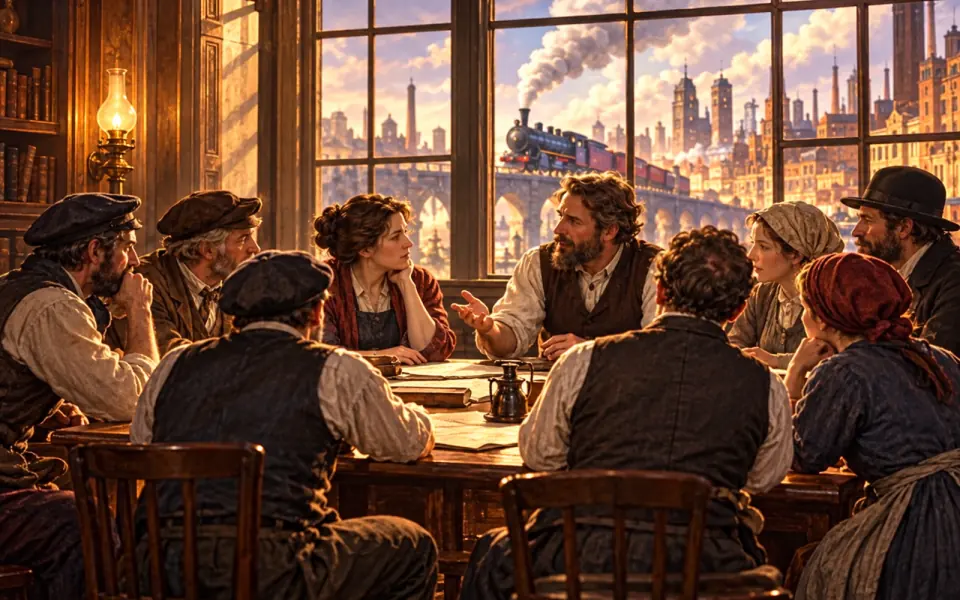
Factories created a new group of workers: factory workers, who often worked twelve or fourteen hours a day for low pay, sometimes from childhood. To defend themselves they began to join together in mutual aid societies and trade unions, and to go on strike. In 1864 the International Workingmen's Association was founded in London, bringing together workers from several countries. One of the most important demands was the eight-hour day.
Why it matters Many of today's workers' rights, such as holidays and limits on working hours, are the result of those struggles.
Source: Treccani, entry “Movimento operaio”
Study card about 5 minutes of reading
The story
Factories and working-class districts
With the Industrial Revolution, between the 18th and 19th centuries, millions of people left the countryside to work in the factories, mines and building sites of the new cities. Living conditions were very hard. People worked twelve, fourteen, even sixteen hours a day, six days a week, for low pay. Machines had no guards, and accidents were frequent. Children worked in spinning mills and mines too, sometimes at six or seven years old, because they cost little and could squeeze into narrow places. Families lived crammed together in crowded, unhealthy districts, with little clean water and a lot of disease.
Workers had no rights at all: if they fell ill or got hurt, they were sacked; if they protested, they risked prison. In many countries workers' associations were banned: in England, for example, the “Combination Acts” were repealed only in 1824.
The first protests
Workers began to organise. At first there were spontaneous revolts, like that of the “Luddites”, who in 1811–16 in England smashed the machines that were leaving them without work. Then the first trade unions were born, and mutual aid societies, in which workers paid in small sums to help each other in case of illness or unemployment. In 1844, at Rochdale, in England, according to tradition twenty-eight workers founded the most famous consumer co-operative, a shop where goods were sold at fair prices and the profits were shared among the members.
Workers also demanded the right to vote: in the 1830s and 1840s, in England, the “Chartist” movement presented Parliament with a “People's Charter” carrying millions of signatures, to demand the vote for all men. Some laws improved workers' conditions a little: in 1833 the English Parliament limited child labour in textile factories, and in 1847 the Ten Hours Act was passed for women and young people.
The International
On 28 September 1864, in a hall in London, St Martin's Hall, English, French, Italian and German delegates met to found the International Workingmen's Association, later called the “First International”. The idea was to unite workers of all countries, because their problems were the same and employers, it was said, worked together across borders: for example, when there were strikes, they could bring in other workers from abroad. The “Inaugural Address” was written by a German philosopher living in London, Karl Marx, and ended with the slogan: “Workers of all countries, unite!”.
The International had tens or hundreds of thousands of members, and far greater influence, but it was divided by clashes between its currents: the followers of Marx, who wanted to win political power, and those of the Russian Mikhail Bakunin, an anarchist, who rejected every state. After the Paris Commune of 1871, a revolutionary government that lasted a few weeks and ended in blood, it was persecuted by governments and dissolved in 1876.
After the International
The workers' movement carried on growing. In 1889 a Second International was born in Paris, which chose 1 May as a day of struggle for the eight-hour working day, in memory of a strike in Chicago in 1886 that ended in deaths and convictions. Since then 1 May has been Workers' Day. In many countries socialist parties and trade unions were born: in Italy the Socialist Party was founded in Genoa in 1892, thanks to Filippo Turati and Anna Kuliscioff, and in 1891 the first Chamber of Labour had been set up in Milan.
There were strikes, some of them violent, and repression. But little by little the demands were met: laws on child labour, on the weekly day of rest and on accidents at work, and the first social insurance and pensions, introduced in the 1880s by the German chancellor Bismarck, to reduce support for the socialists.
Why it happened
The workers' movement was born from the terrible living and working conditions created by industrialisation, and from workers' awareness that, united, they could win more. The ideas of socialists, co-operators and anarchists gave that anger a direction and a plan.
Better communications mattered too: newspapers, trains and the telegraph allowed workers in different countries to exchange news and make common cause.
What changed
The workers' movement changed society deeply. Thanks to workers' struggles, and to the work of reformers and politicians, rights were won that today seem normal to us: the eight-hour day, Sunday rest, holidays, safety at work, pensions, health care, the ban on child labour, the right to strike and to organise in trade unions, the vote for all.
In Italy, the Constitution of 1948 says, in Article 1, that “Italy is a democratic Republic, founded on labour”, and recognises freedom of trade unions and the right to strike. In 1970 the Workers' Statute strengthened protections in factories.
Today the problems are different: insecure jobs, the rights of workers on digital platforms, safety, equal pay for men and women. But the history of workers is a reminder that rights are never guaranteed for ever, and that many are the fruit of long and difficult battles.
Key people and places
People
- Karl Marx
- German philosopher and economist (1818–1883): he wrote the inaugural address of the First International.
- Friedrich Engels
- German philosopher and industrialist (1820–1895): friend and collaborator of Marx.
- Mikhail Bakunin
- Russian revolutionary (1814–1876): founder of modern anarchism, Marx's rival in the International.
- Filippo Turati
- Italian politician and journalist (1857–1932): founder of the Socialist Party.
- Anna Kuliscioff
- Revolutionary and doctor of Russian origin (1857–1925): one of the founders of Italian socialism.
Places
- St Martin's Hall, London
- The hall where the First International was founded in 1864.
- Genoa
- The city where the Italian Socialist Party was born in 1892.
Good to know
- The First International was founded in London on 28 September 1864.
- 1 May is Workers' Day in memory of the struggles for the eight-hour working day.
- The first English trade unions were banned until 1824.
- The most famous consumer co-operative was born at Rochdale in 1844.
- Article 1 of the Italian Constitution says that the Republic is “founded on labour”.
Find out more
- Wikipedia, “First International” en.wikipedia.org
- Wikipedia, “Labour Day” en.wikipedia.org
- Wikipedia, “Labour movement” en.wikipedia.org
- Wikipedia, “Anna Kuliscioff” en.wikipedia.org
Related events
- Watt's steam engine1769 · Age of revolutionsWatt's steam engine had set industrialisation in motion.
- The Russian Revolution1917 · Early 20th centuryThe Russian Revolution also grew out of the workers' movement.
- The Italian Constitution1948 · Early 20th centuryThe Italian Constitution is “founded on labour”.
- The revolutions of 18481848 · Age of revolutionsIn 1848 the Communist Manifesto had come out.
Before and after, in the era “Age of revolutions”
Event 21 of 25
 BeforeNewcomen's steam engine1712
 BeforeThe European Enlightenmentabout 1720
 BeforeDiderot's Encyclopédie1751
 BeforeWatt's steam engine1769
 BeforeThe American Revolution1776–1783
 BeforeThe first hot-air balloon flight1783
 BeforeThe French Revolution1789–1799
 BeforeThe metric system1795
 BeforeJenner's vaccine1796
 BeforeVolta's battery1800
 BeforeNapoleon becomes emperor1804
 BeforeThe Congress of Vienna1815
 BeforeThe first public steam railway1825
 BeforeNiépce's photographabout 1826
 BeforeManzoni's The Betrothed1827
 BeforeThe electric telegraph1844
 BeforeThe revolutions of 18481848
 BeforeDarwin publishes On the Origin of Species1859
 BeforeThe Expedition of the Thousand1860
 BeforeThe unification of Italy1861
- You are hereThe labour movementabout 1864
 AfterCompulsory primary school (Coppino law)1877
 AfterA practical electric light bulb1879
 AfterThe first modern motor car1886
 AfterThe Lumière brothers' cinema1895
Listen / Read next
- Music to read by: Cinematic JourneyEpic film-style music, no lyrics, by Ciro Simone IrmiciSpotifyYouTube Music
Meanwhile, elsewhere in the world
Other events of the era “Age of revolutions”
- Newcomen's steam engine
- The European Enlightenment
- Diderot's Encyclopédie
- Watt's steam engine
- The American Revolution
- The first hot-air balloon flight
- The French Revolution
- The metric system
- Jenner's vaccine
- Volta's battery
- Napoleon becomes emperor
- The Congress of Vienna
- The first public steam railway
- Niépce's photograph
- Manzoni's The Betrothed
- The electric telegraph
- The revolutions of 1848
- Darwin publishes On the Origin of Species
- The Expedition of the Thousand
- The unification of Italy
- Compulsory primary school (Coppino law)
- A practical electric light bulb
- The first modern motor car
- The Lumière brothers' cinema
