The first image of a black hole
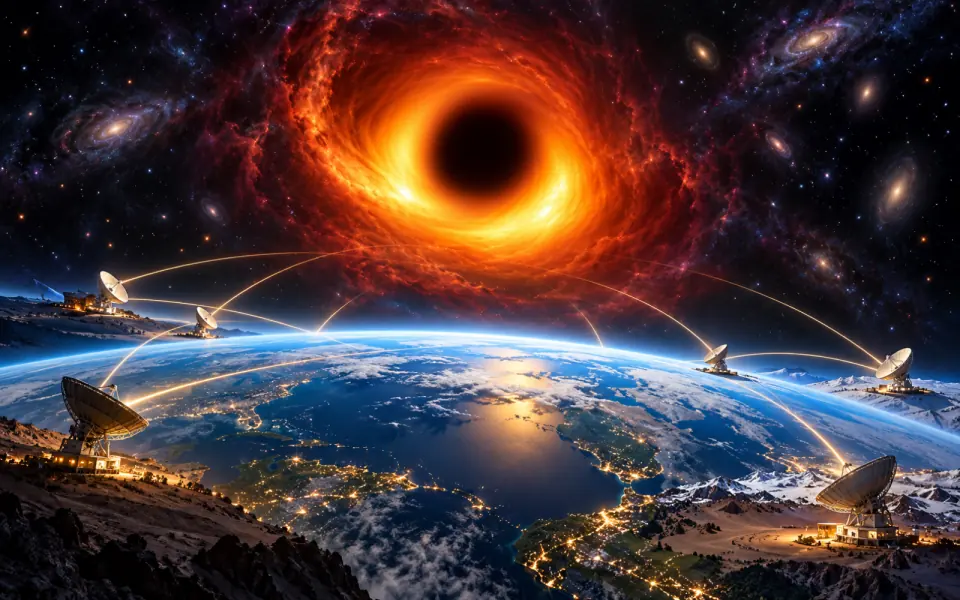
2019 Galaxy M87, observed by eight radio telescopes around the world (including ALMA, in Chile)
In short
A black hole has such strong gravity that not even light can escape from it, which is why it cannot be seen directly. By linking eight radio telescopes scattered around the world, the scientists of the Event Horizon Telescope created the equivalent of a telescope almost as big as the Earth. On 10 April 2019 they showed the first image of the shadow of a black hole, surrounded by a bright ring. It lies at the centre of the galaxy M87, about 55 million light years away, and has a mass of 6.5 billion Suns.
Why it matters It confirmed with a real image what Einstein's theory of relativity predicted.
Source: ESO, “Astronomers Capture First Image of a Black Hole” (press release eso1907)
Study card about 5 minutes of reading
The story
A star so heavy
A black hole is one of the strangest objects in the universe. It is usually born when a star much bigger than the Sun runs out of fuel and collapses in on itself: all its matter is squeezed into a tiny space. Gravity, the force that pulls things together, becomes so strong that nothing, not even light, can escape any more. That is why you cannot see it: it is “black”. Its edge is called the “event horizon”: anything that crosses it can never come back.
The idea goes back to Einstein. In 1915 he published the theory of general relativity, according to which gravity is a curving of space and time. A few months later the German astronomer Karl Schwarzschild, who was at the front during the First World War, found a solution to his equations that described exactly such an object. Einstein himself, however, did not believe it could really exist. The name “black hole” was made famous in 1967 by the American physicist John Wheeler.
Indirect evidence
For decades black holes remained a hypothesis. Then astronomers began to find traces of them: stars orbiting an invisible point, gas falling into a whirlpool and becoming extremely hot, giving off X-rays, and even, in 2015, gravitational waves, tiny vibrations of space caused by the merging of two black holes, picked up by the LIGO instruments. But one thing was missing: seeing one.
A telescope as big as the Earth
Photographing a black hole is an enormous task. Even the biggest ones are very far away and, seen from the Earth, look tiny, like trying to see an orange on the Moon. To get such a sharp image you would need a telescope as big as our planet. Scientists had an idea: to link radio telescopes in places very far apart, and make them all work together as a single giant telescope. This is how the Event Horizon Telescope was born.
In April 2017 eight radio telescopes, in Chile, Hawaii, Arizona, Mexico, Spain and at the South Pole, pointed for a few days at the same target: the centre of a big galaxy called M87, about 55 million light years from the Earth. The telescopes recorded enormous amounts of data, about five petabytes, so much that it could not be sent over the Internet: it was loaded onto hundreds of disks and flown by plane to two computing centres, in the United States and in Germany. For two years more than two hundred scientists from many countries worked to reconstruct the image: among them was a young computer scientist, Katie Bouman, who became famous when a photograph of her next to the disks went around the web, although it was teamwork, to which many people contributed.
The image
On 10 April 2019, at press conferences in Brussels, Washington, Tokyo, Santiago and other cities, the first photograph of a black hole was shown: an orange ring of blurred light around a black patch in the middle. The ring is gas swirling at enormous speed around the black hole and heating up; the dark area is its shadow. The black hole in M87 weighs about six and a half billion times as much as the Sun, and its horizon is bigger than the whole Solar System.
In 2022 the same team published a photograph of another black hole, the one at the centre of our own galaxy, the Milky Way, called Sagittarius A*, about 27,000 light years away and with a mass of about four million Suns. Here too, a bright ring around a dark centre.
Why it happened
The photograph came from a century-old theory, general relativity, which predicted the existence and appearance of black holes. But new technologies were needed: very sensitive radio telescopes, atomic clocks able to synchronise data from distant places, supercomputers and algorithms to reconstruct the image.
Collaboration mattered too: no country could have done it all on its own. The idea of joining telescopes all over the world was championed above all by scientists such as Heino Falcke, in the Netherlands, and Sheperd Doeleman, in the United States.
What changed
The 2019 image confirmed that Einstein was right even in an extreme case: the shape of the shadow matched what had been calculated with relativity. It has opened up a new field of study, in which people look for films of black holes and their “jets” of matter.
Black holes are not “vacuum cleaners” that swallow everything: far away from them, a black hole attracts things just like any star of the same mass. But they are essential for understanding how galaxies are born and grow: almost all of them, including ours, have a giant one at the centre.
In 2020 the Nobel Prize in Physics was awarded to Roger Penrose, for showing that black holes are a consequence of general relativity, and to Reinhard Genzel and Andrea Ghez, for discovering the black hole at the centre of our galaxy.
Key people and places
People
- Albert Einstein
- German physicist (1879–1955): with general relativity (1915) he laid the theoretical foundations of black holes.
- Karl Schwarzschild
- German astronomer (1873–1916): he found the first solution of Einstein's equations that describes a black hole.
- Heino Falcke
- German astrophysicist (born 1966): he proposed photographing the shadow of a black hole.
- Sheperd Doeleman
- American astrophysicist (born 1967): he directed the Event Horizon Telescope.
- Katie Bouman
- American computer scientist (born 1989): one of the researchers who reconstructed the black hole image.
Places
- Galaxy M87, in the constellation Virgo
- The black hole photographed in 2019 is at the centre of this big galaxy, about 55 million light years away.
- Atacama Desert, Chile
- Home of ALMA, one of the radio telescopes of the Event Horizon Telescope.
Good to know
- The Event Horizon Telescope used telescopes in Chile, Hawaii, Arizona, Mexico, Spain and at the South Pole.
- The data recorded in 2017 took up about five petabytes and was flown by plane on hundreds of disks.
- The black hole in M87 has a mass about 6.5 billion times that of the Sun.
- The words “black hole” were made famous in 1967 by the physicist John Wheeler.
- The image shows a ring of orange light: it is extremely hot gas swirling around the black hole.
Find out more
- ESO, “Astronomers Capture First Image of a Black Hole” eso.org
- Event Horizon Telescope, official website eventhorizontelescope.org
- Wikipedia, “Black hole” en.wikipedia.org
- Wikipedia, “Event Horizon Telescope” en.wikipedia.org
Related events
- Special relativity1905 · Early 20th centuryEinstein's relativity explains black holes.
- Galileo turns his telescope to the sky1609 · Early modern ageGalileo was the first to use the telescope to look at the sky.
- The Webb telescope starts observing2022 · TodayThe Webb telescope looks even further into the universe.
- Newton publishes the Principia1687 · Early modern ageNewton had explained gravity in 1687.
Before and after, in the era “Today”
Event 23 of 25
 BeforeThe double helix of DNA1953
 BeforeThe polio vaccine1955
 BeforeBirth of the European Community1957
 BeforeThe first artificial satellite1957
 BeforeThe first human in space1961
 BeforePop artabout 1962
 BeforeThe Beatles1963
 BeforeMartin Luther King and civil rights1963
 BeforeThe Moon landing1969
 BeforeThe internet's first ARPANET links1969
 BeforeEarth Day and the environmental movement1970
 BeforeThe personal computer1977
 BeforeThe fall of the Berlin Wall1989
 BeforeThe World Wide Web1991
 BeforeThe European Union1993
 BeforeNelson Mandela becomes president1994
 BeforeThe International Space Station1998
 BeforeEuro notes and coins arrive2002
 BeforeThe modern smartphone2007
 BeforeThe global financial crisis2008
 BeforeMalala wins the Nobel Peace Prize2014
 BeforeThe Paris Agreement on climate2015
- You are hereThe first image of a black hole2019
 AfterThe COVID-19 pandemic2020
 AfterThe Webb telescope starts observing2022
Listen / Read next
- Music to read by: Cinematic JourneyEpic film-style music, no lyrics, by Ciro Simone IrmiciSpotifyYouTube Music
Meanwhile, elsewhere in the world
Other events of the era “Today”
- The double helix of DNA
- The polio vaccine
- Birth of the European Community
- The first artificial satellite
- The first human in space
- Pop art
- The Beatles
- Martin Luther King and civil rights
- The Moon landing
- The internet's first ARPANET links
- Earth Day and the environmental movement
- The personal computer
- The fall of the Berlin Wall
- The World Wide Web
- The European Union
- Nelson Mandela becomes president
- The International Space Station
- Euro notes and coins arrive
- The modern smartphone
- The global financial crisis
- Malala wins the Nobel Peace Prize
- The Paris Agreement on climate
- The COVID-19 pandemic
- The Webb telescope starts observing
