The first human in space
1961 Baikonur (now Kazakhstan) and Earth orbit
In short
On 12 April 1961 the Soviet pilot Yuri Gagarin took off from the Baikonur Cosmodrome aboard the Vostok 1 capsule. The flight lasted 108 minutes, with one complete orbit of the Earth, climbing to more than 300 kilometres high. At lift-off he called out ‘Poyekhali!’, meaning ‘Let's go!’. To land he ejected from the capsule and came down by parachute, and he became famous all over the world. Two years later Valentina Tereshkova became the first woman in space.
Why it matters It proved that a human being can live and work in space.
Source: ESA, “Yuri Gagarin: first man in space”
Study card about 5 minutes of reading
The story
A country boy
Yuri Gagarin was born in 1934 in a farming village, Klushino, near Smolensk, in Russia. His father was a carpenter, his mother worked on the farm. As a child he saw his village occupied by German soldiers during the war: the family was thrown out of their house and lived for years in a hut. After school he worked in a foundry, then went to study at a technical school and an aeroclub, where he learned to fly small planes. In 1957 he became an air force pilot.
Meanwhile, in his country, a secret programme had begun to send a man into space. They needed pilots who were tough, clever and small, because the capsule was cramped: Gagarin, 1.57 metres tall, was perfect. He was chosen along with nineteen other candidates and trained for months: long tests in the centrifuge, which simulates the forces of launch, isolated and silent rooms, parachute jumps. At the end of the selection the doctors and the heads of the programme chose him. Everybody liked him: he was always smiling, modest and friendly.
The 108-minute flight
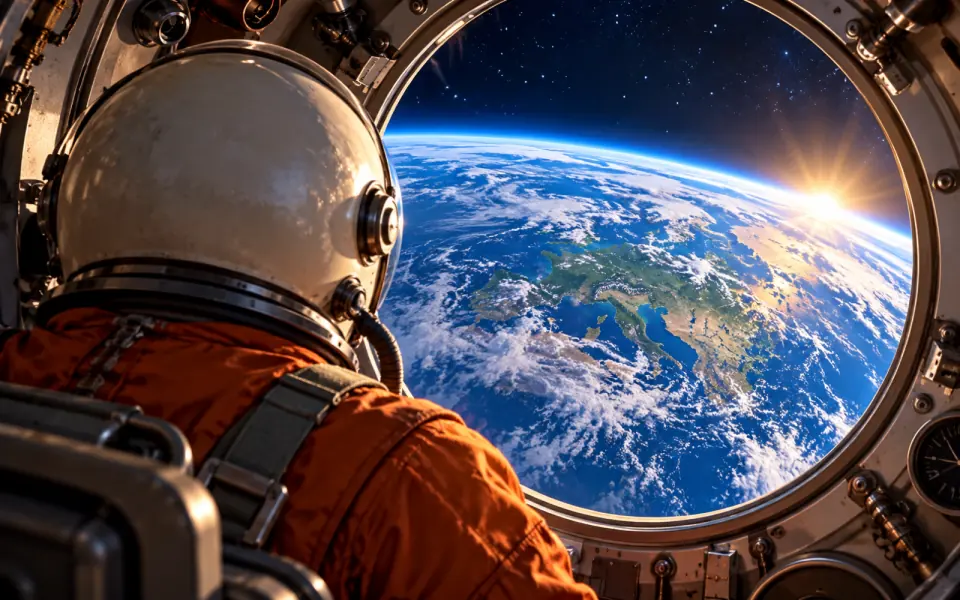
On the morning of 12 April 1961 Gagarin, wearing his orange suit, climbed aboard the rocket at the Baikonur base, in Kazakhstan. The capsule was called Vostok, “East”. As the engine was starting up, he said a phrase that was destined to last: “Poyekhali!”, meaning “Let's go!”. The rocket carried him more than 300 kilometres from the Earth, at a speed of about 27,000 kilometres an hour.
The flight was almost completely automatic: nobody yet knew how the human body would react without weight, and the engineers feared that the astronaut might lose control. For safety, the manual controls were locked with a code, written in an envelope, which Gagarin would open only if he needed to. During the flight he ate and drank, wrote with a pencil and noted that objects were floating. Looking out of the window he said that the Earth was beautiful and blue.
After just one orbit of the planet, in 108 minutes, the capsule re-entered the atmosphere, surrounded by fire. At a height of about seven kilometres Gagarin ejected from the capsule on an ejection seat and came down by parachute. He landed near the village of Smelovka, in the Saratov region, where a farm woman and her little granddaughter saw him arrive: frightened by his orange suit, they asked him if he came from space. He answered that they should not be afraid: he was one of them, but he did come from space and needed to find a telephone to call Moscow.
The first hero of the space age
Within a few hours Gagarin became famous all over the world. Moscow held a huge celebration, and for months Gagarin travelled to many countries, welcomed by joyful crowds. At just 27 he had become the symbol of scientific progress, the first of a new breed of explorers. The United States, surprised once again after Sputnik, answered quickly: on 5 May 1961 Alan Shepard made a short flight into space and, a few weeks later, President Kennedy announced that before the end of the decade America would put a man on the Moon.
Gagarin never flew in space again: his government did not want to risk the life of a national hero. He became an instructor of the new cosmonauts and went back to flying planes too. He died on 27 March 1968, aged 34, in an accident during a training flight in a fighter jet, near Moscow. Today 12 April is remembered all over the world as the “International Day of Human Space Flight”, by a United Nations resolution of 2011.
Why it happened
After the launch of Sputnik in 1957, the race with the United States had become a matter of prestige. The Soviet Union wanted to show that its system was the most advanced, and the first man in space would be the most spectacular proof.
From a technical point of view, the success was possible thanks to the dogs and other animals sent into orbit earlier (Belka and Strelka came back safe and sound in 1960), which showed that a living creature could survive the flight and the return. The designer Sergei Korolev and his team prepared everything with great care, but also with great risks: in December 1960 another test, with two dogs on board, had ended badly.
What changed
Gagarin's flight showed that humans could live and work in space. It opened the way to an age of achievements: the first woman in space, Valentina Tereshkova in 1963, the first spacewalk in 1965, and the Moon landing in 1969.
It was also the start of the great race between the Soviet Union and the United States. Kennedy answered with a programme, Apollo, that cost enormous sums of money and involved hundreds of thousands of people. Since then, space has become a place of work and of international cooperation, all the way to today's space stations.
This “first” in space flight inspired generations of engineers, scientists and children. Even today at Baikonur the traditions born in Gagarin's time are kept alive with affection, and his name is remembered all over the world.
Key people and places
People
- Yuri Gagarin
- Soviet cosmonaut (1934–1968): the first human in space, on 12 April 1961.
- Sergei Korolev
- Soviet engineer (1907–1966): chief designer of Gagarin's rocket and spacecraft.
- Valentina Tereshkova
- Soviet cosmonaut (born 1937): the first woman in space, in 1963.
- Alan Shepard
- American astronaut (1923–1998): the first American in space, on 5 May 1961.
- John F. Kennedy
- President of the United States (1917–1963): he set the challenge of going to the Moon.
Places
- Baikonur, Kazakhstan
- The Vostok with Gagarin took off from this cosmodrome, and many rockets still do today.
- Smelovka, Saratov region (Russia)
- The village near which Gagarin landed by parachute.
Good to know
- Gagarin was only 157 centimetres tall: the Vostok capsule was very small.
- Before Gagarin, two dogs, Belka and Strelka, had made an orbital flight and returned to Earth safe and sound.
- Gagarin did not land inside the capsule: at a height of seven kilometres he jumped out and used his parachute.
- The flight lasted 108 minutes, just one orbit of the Earth.
- 12 April is the International Day of Human Space Flight, established by the United Nations in 2011.
Find out more
- ESA, “I see Earth! It is so beautiful!” esa.int
- Wikipedia, “Yuri Gagarin” en.wikipedia.org
- Wikipedia, “Vostok 1” en.wikipedia.org
- UNOOSA, “International Day of Human Space Flight” unoosa.org
Related events
- The first artificial satellite1957 · TodayFour years earlier, Sputnik had opened the way to human spaceflight.
- The Moon landing1969 · TodayEight years later the Americans reached the Moon.
- The International Space Station1998 · TodayToday astronauts from many countries live together on the Space Station.
- Television spreadsabout 1950 · Early 20th centuryTelevision brought space achievements live into people's homes.
Before and after, in the era “Today”
Event 5 of 25
 BeforeThe double helix of DNA1953
 BeforeThe polio vaccine1955
 BeforeBirth of the European Community1957
 BeforeThe first artificial satellite1957
- You are hereThe first human in space1961
 AfterPop artabout 1962
 AfterThe Beatles1963
 AfterMartin Luther King and civil rights1963
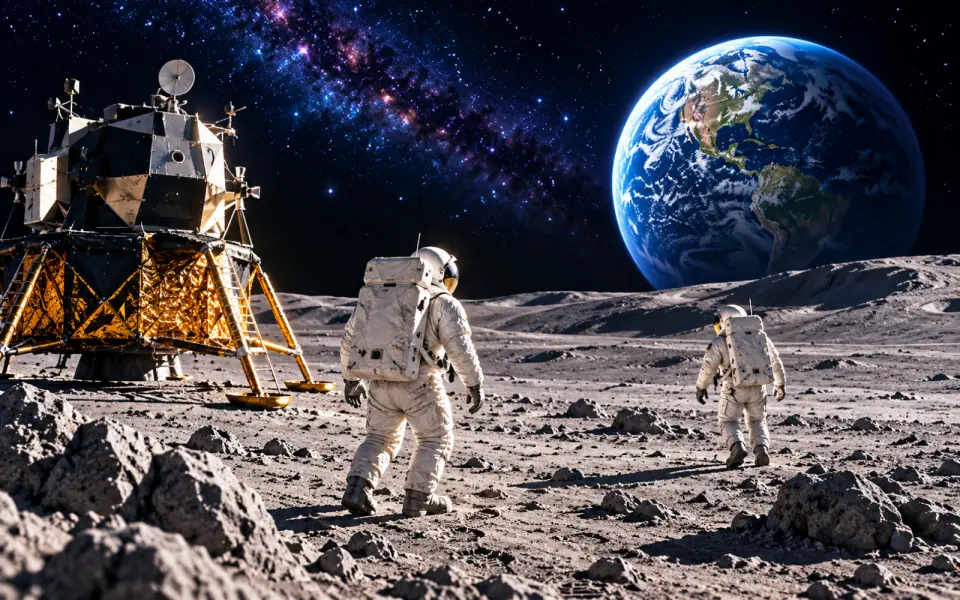 AfterThe Moon landing1969
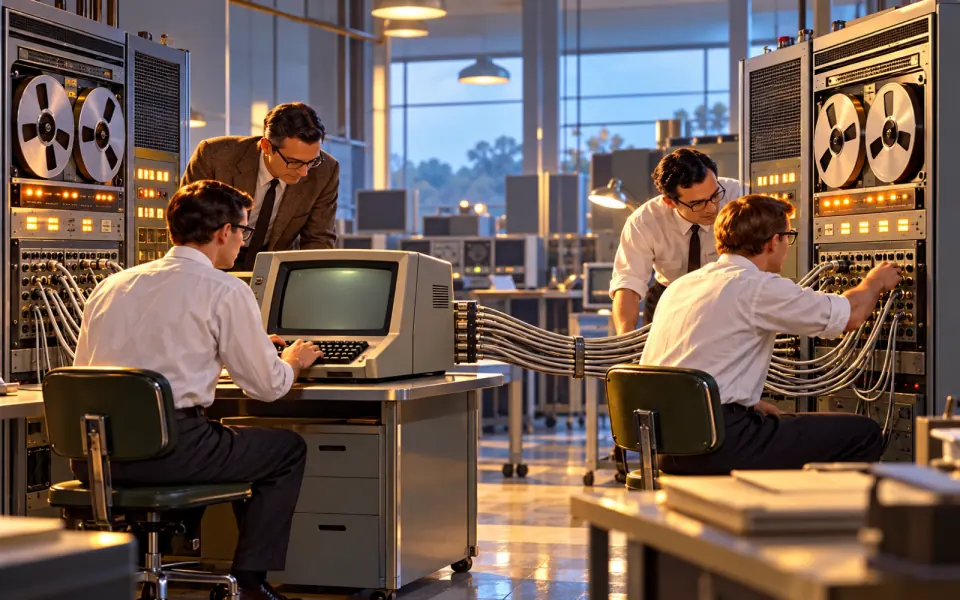 AfterThe internet's first ARPANET links1969
 AfterEarth Day and the environmental movement1970
 AfterThe personal computer1977
 AfterThe fall of the Berlin Wall1989
 AfterThe World Wide Web1991
 AfterThe European Union1993
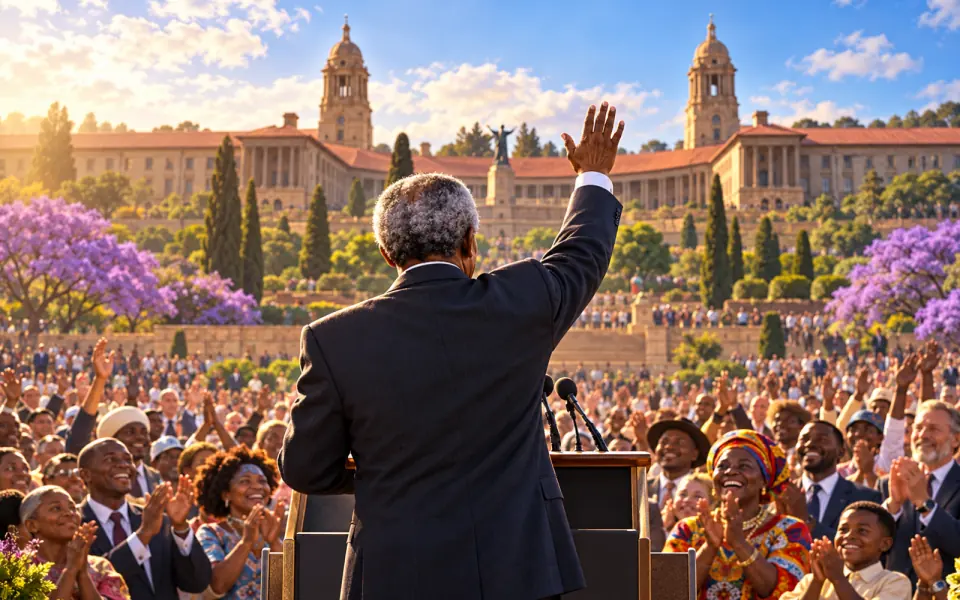 AfterNelson Mandela becomes president1994
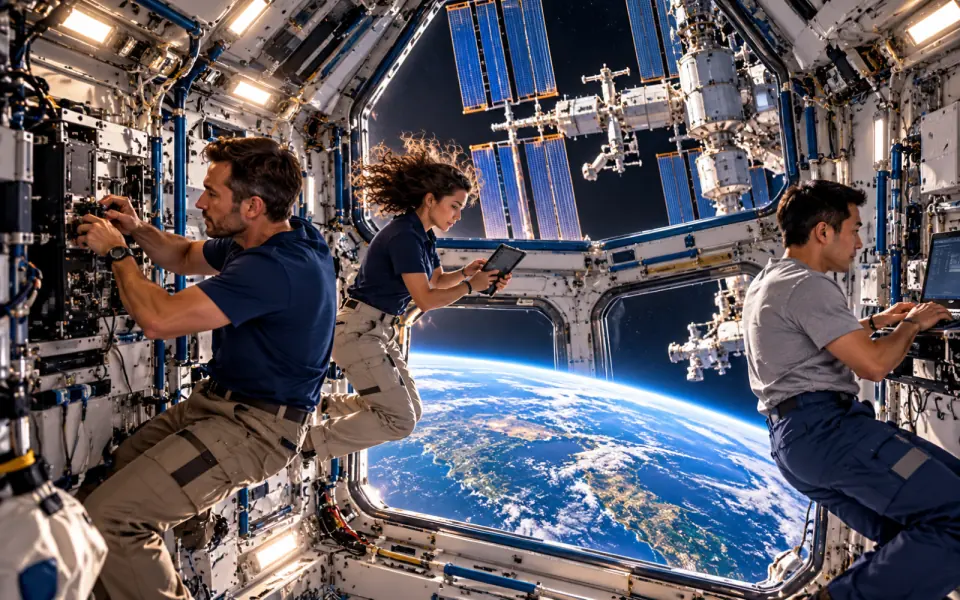 AfterThe International Space Station1998
 AfterEuro notes and coins arrive2002
 AfterThe modern smartphone2007
 AfterThe global financial crisis2008
 AfterMalala wins the Nobel Peace Prize2014
 AfterThe Paris Agreement on climate2015
 AfterThe first image of a black hole2019
 AfterThe COVID-19 pandemic2020
 AfterThe Webb telescope starts observing2022
Listen / Read next
- Music to read by: Cinematic JourneyEpic film-style music, no lyrics, by Ciro Simone IrmiciSpotifyYouTube Music
Meanwhile, elsewhere in the world
Other events of the era “Today”
- The double helix of DNA
- The polio vaccine
- Birth of the European Community
- The first artificial satellite
- Pop art
- The Beatles
- Martin Luther King and civil rights
- The Moon landing
- The internet's first ARPANET links
- Earth Day and the environmental movement
- The personal computer
- The fall of the Berlin Wall
- The World Wide Web
- The European Union
- Nelson Mandela becomes president
- The International Space Station
- Euro notes and coins arrive
- The modern smartphone
- The global financial crisis
- Malala wins the Nobel Peace Prize
- The Paris Agreement on climate
- The first image of a black hole
- The COVID-19 pandemic
- The Webb telescope starts observing
