The International Space Station
1998 In orbit around the Earth (first module launched from Baikonur)
In short
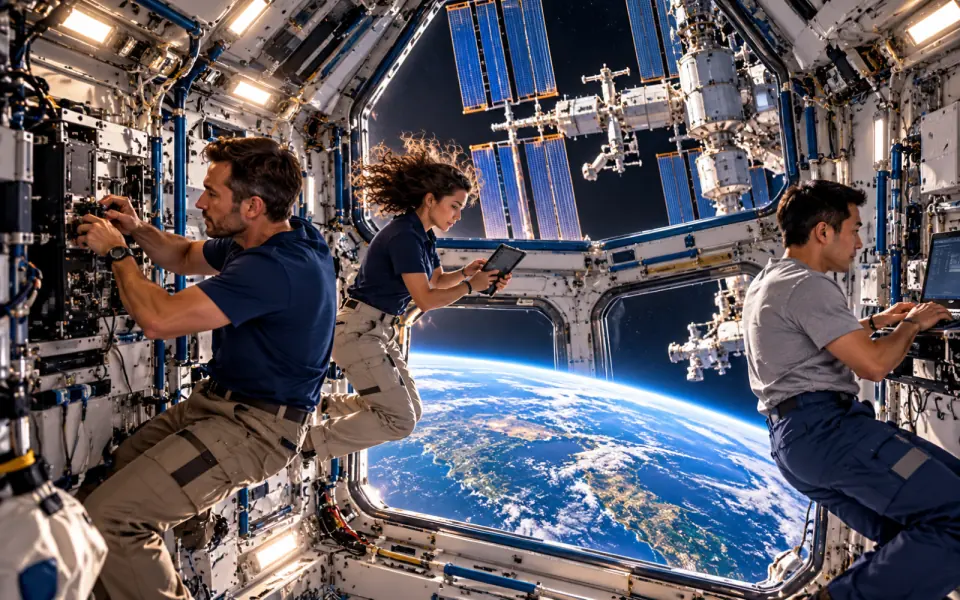
On 20 November 1998 a Russian rocket launched Zarya, the first piece of the International Space Station. In the following years modules from the United States, Russia, Europe, Japan and Canada were added, and some were built in Italy, in Turin. Since November 2000 the station has always had astronauts living on board and carrying out scientific experiments. It flies about 400 kilometres up; Italians have been on board too, such as Samantha Cristoforetti and Luca Parmitano.
Why it matters It is the largest project of international cooperation in space, a laboratory for studying how to live far from the Earth.
Source: ESA, “International Space Station”
Study card about 5 minutes of reading
The story
From enemies to neighbours
For many years the United States and the Soviet Union were rivals in space. But after the end of the Cold War, in 1991, things changed: the two countries began to cooperate. In 1995 the first American shuttle docked with the Russian space station Mir, and astronauts and cosmonauts lived together in space. It was a dress rehearsal for an even bigger station, built by many countries: the International Space Station, abbreviated ISS.
The project brought together five space agencies: America's NASA, Russia's Roscosmos, Europe's ESA, Japan's JAXA and the Canadian Space Agency. Each built parts at home, and all the parts had to fit together perfectly in orbit, 400 kilometres up, without anyone being able to test them together first on Earth.
A puzzle in space
The first brick, a Russian module called Zarya, “Dawn”, was launched on 20 November 1998 from Baikonur. A few weeks later, in December, the shuttle Endeavour brought Unity, the first American module, and the astronauts connected it to Zarya with a manoeuvre using the robotic arm. Since then, over more than twenty-five years and with more than forty assembly flights, the station has grown piece by piece, with new laboratories, solar panels, pipes, nodes and windows.
On 2 November 2000 the first three residents arrived, the American Bill Shepherd and the Russians Yuri Gidzenko and Sergei Krikalev, who lived on board for more than four months. Since then the station has been inhabited without a break. Today there is usually a crew of seven, who change about every six months and travel on the Russian Soyuz craft and the American capsules.
What it is like
Fully assembled, the station is about 109 metres long and 73 wide, roughly the size of a football pitch, and weighs over 400 tonnes. It is the biggest human-made object in space. It travels at about 28,000 kilometres an hour and goes round the Earth in 92 minutes: the astronauts see the Sun rise and set sixteen times a day. There are laboratories for experiments, a gym, where every day the astronauts exercise for two hours so as not to lose muscle and bone, sleeping quarters, a toilet and a dome with seven windows for looking at the Earth.
Europe and Italy played an important part: many modules, including the nodes Harmony and Tranquility, and the Cupola, the panoramic window, were made in Turin, at a Thales Alenia Space plant. The European laboratory is called Columbus and has been in orbit since 2008.
A day on board follows Greenwich time: the astronauts wake up, have breakfast, take part in a short meeting with the control centres in Houston and Moscow, and then spend the hours on experiments, repairs and maintenance of the systems, because such a complicated machine always needs care. In the evening there is time to phone home and watch the Earth gliding by under their feet through the windows.
Life without weight
On board the station everything floats: the astronauts sleep in sleeping bags tied to the walls, eat special food with straws and drink water from pouches. They use machines that recycle water, even from breath and sweat. They carry out experiments that would be impossible on Earth, because without weight materials, flames, cells and plants behave differently. Among the Italian astronauts who have lived on board are Umberto Guidoni, Paolo Nespoli, Luca Parmitano and Samantha Cristoforetti, who in 2022 became the first European woman to command the station.
Why it happened
The station was born from the end of the Cold War and from the realisation that such a large and costly laboratory was too much for a single country. The Russians had the experience of the Salyut and Mir stations, the Americans had the shuttles and the money; the Europeans, Japanese and Canadians brought technology and modules.
For scientists there was another important reason: to be able to study for a long time, in a continuously inhabited laboratory, the effects of weightlessness on the human body and on materials, in preparation for longer journeys, for example to Mars.
What changed
The ISS has been the first great enterprise of international scientific cooperation in space. More than 270 people from over twenty countries have visited it, and thousands of experiments have been carried out in its laboratories, from medicine to materials, from plant growth to the study of cosmic rays.
It has taught us how to live and work in space for a long time: we now know much more about how the human body reacts to weightlessness, and about how to make repairs, feed ourselves and produce water in a closed environment. Technologies created for the station, such as water purification systems, are also used on Earth.
The station will not last for ever: the agencies plan to abandon it around 2030 and to guide it in a controlled way towards the ocean. Other stations, run by agencies and by private companies, and new missions to the Moon and Mars will take up the baton.
Key people and places
People
- Samantha Cristoforetti
- Italian astronaut and pilot (born 1977): in 2022 she was the first European woman to command the ISS.
- Paolo Nespoli
- Italian astronaut (born 1957): he lived on the ISS in three missions.
- Luca Parmitano
- Italian astronaut (born 1976): the first Italian to command the ISS, in 2019.
- Sergei Krikalev
- Russian cosmonaut (born 1958): one of the first three residents of the ISS in 2000.
- William Shepherd
- American astronaut (born 1949): commander of the ISS's first crew.
Places
- International Space Station, Earth orbit
- About 400 kilometres up: it passes over Italy several times a day.
- Thales Alenia Space, Turin
- Many modules of the station were built here, including Harmony and the Cupola.
Good to know
- The station goes round the Earth in about 92 minutes: the astronauts see sixteen sunrises a day.
- On board, astronauts exercise for about two hours a day so as not to lose muscle and bone.
- The station has been continuously inhabited since 2 November 2000.
- It is about the size of a football pitch and weighs over 400 tonnes.
- Five space agencies cooperate on the ISS: NASA, Roscosmos, ESA, JAXA and CSA.
Find out more
- ESA, “International Space Station” esa.int
- NASA, “International Space Station” nasa.gov
- Wikipedia, “International Space Station” en.wikipedia.org
- Wikipedia, “Samantha Cristoforetti” en.wikipedia.org
Related events
- The first artificial satellite1957 · TodaySputnik opened the age of satellites, which includes the station.
- The first human in space1961 · TodayGagarin was the first man in space, almost forty years earlier.
- The Moon landing1969 · TodayThe Moon landing was the great achievement of the 20th century.
- The Webb telescope starts observing2022 · TodayThe Webb telescope continues the exploration from space.
Before and after, in the era “Today”
Event 17 of 25
 BeforeThe double helix of DNA1953
 BeforeThe polio vaccine1955
 BeforeBirth of the European Community1957
 BeforeThe first artificial satellite1957
 BeforeThe first human in space1961
 BeforePop artabout 1962
 BeforeThe Beatles1963
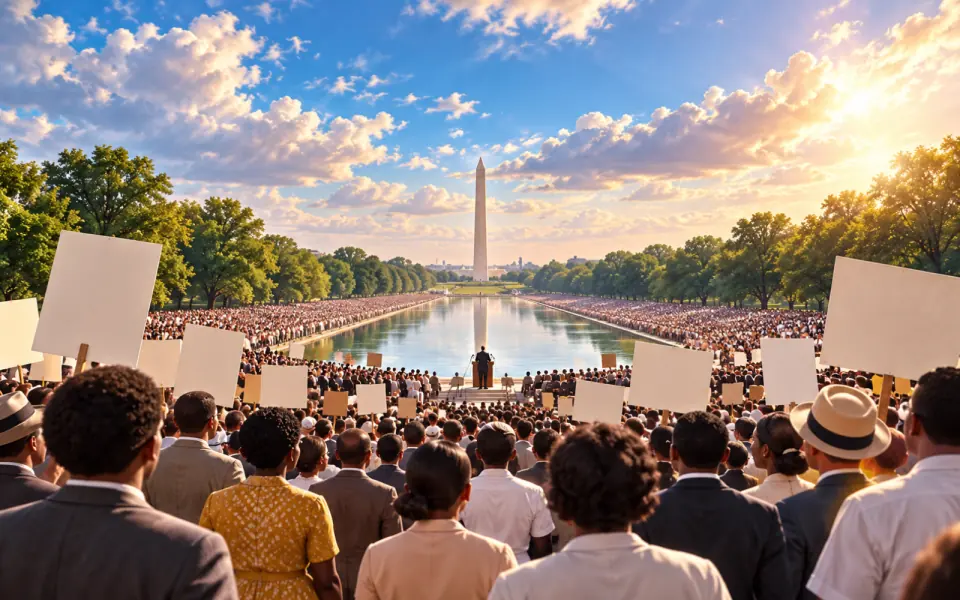 BeforeMartin Luther King and civil rights1963
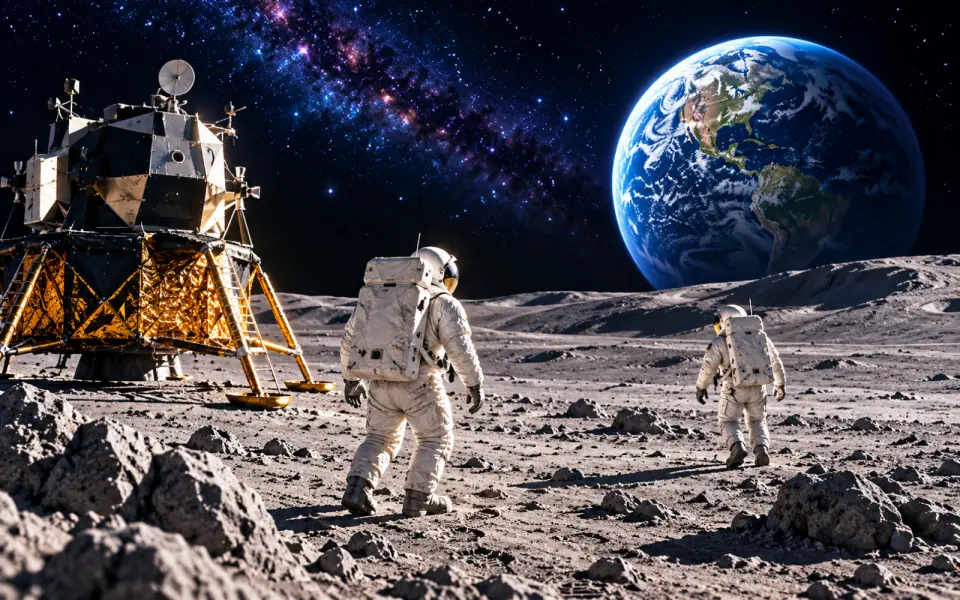 BeforeThe Moon landing1969
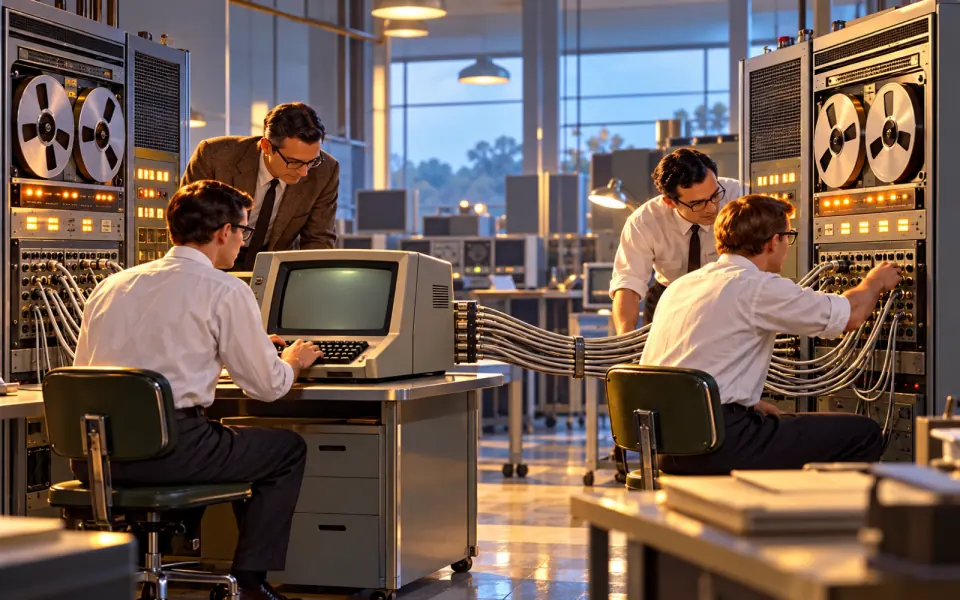 BeforeThe internet's first ARPANET links1969
 BeforeEarth Day and the environmental movement1970
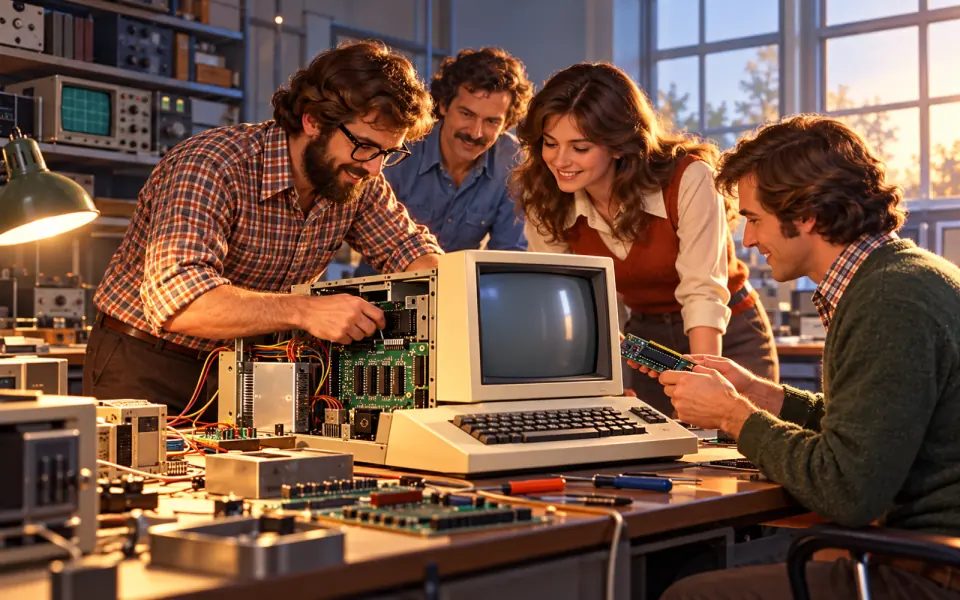 BeforeThe personal computer1977
 BeforeThe fall of the Berlin Wall1989
 BeforeThe World Wide Web1991
 BeforeThe European Union1993
 BeforeNelson Mandela becomes president1994
- You are hereThe International Space Station1998
 AfterEuro notes and coins arrive2002
 AfterThe modern smartphone2007
 AfterThe global financial crisis2008
 AfterMalala wins the Nobel Peace Prize2014
 AfterThe Paris Agreement on climate2015
 AfterThe first image of a black hole2019
 AfterThe COVID-19 pandemic2020
 AfterThe Webb telescope starts observing2022
Listen / Read next
- Music to read by: Cinematic JourneyEpic film-style music, no lyrics, by Ciro Simone IrmiciSpotifyYouTube Music
Meanwhile, elsewhere in the world
Other events of the era “Today”
- The double helix of DNA
- The polio vaccine
- Birth of the European Community
- The first artificial satellite
- The first human in space
- Pop art
- The Beatles
- Martin Luther King and civil rights
- The Moon landing
- The internet's first ARPANET links
- Earth Day and the environmental movement
- The personal computer
- The fall of the Berlin Wall
- The World Wide Web
- The European Union
- Nelson Mandela becomes president
- Euro notes and coins arrive
- The modern smartphone
- The global financial crisis
- Malala wins the Nobel Peace Prize
- The Paris Agreement on climate
- The first image of a black hole
- The COVID-19 pandemic
- The Webb telescope starts observing
